
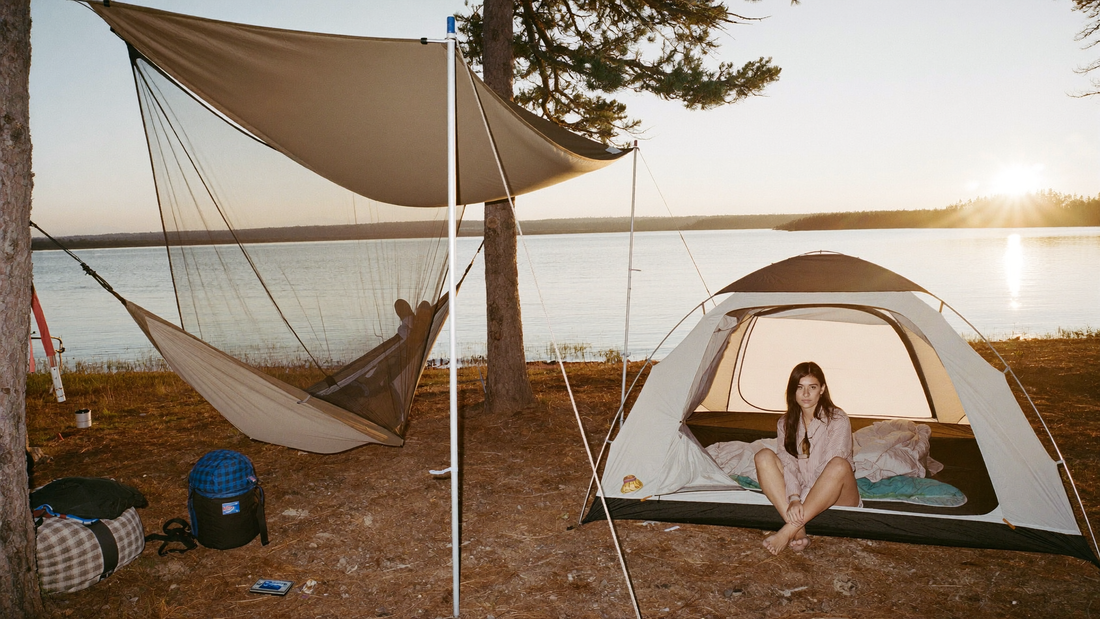
There's a specific kind of tired that only a bad stretch at work produces, and there's a specific kind of cure for it: two nights outside with your phone in the glovebox. Every so often the same story pops up in camping forums. Someone finally escapes the office, tries sleeping in a hammock for the first time, and wakes up genuinely surprised. Not "it was fine" surprised. "I might prefer this to my tent" surprised.
That's worth paying attention to, because most hammock camping vs tent comparisons are written by people who already picked a side, usually ultralight backpackers who count grams for fun. This one is for family campers and car campers who mostly want to sleep well enough to enjoy the next day. From that seat, the answer really is "it depends": on your body, who's coming with you, and where you camp.
Hammock camping vs tent: the quick answer
| Hammock | Tent | |
|---|---|---|
| Sleep quality | Surprisingly good for back sleepers and most solo campers; zero pressure points, no roots or rocks | Best for side sleepers, couples, and kids, if you invest in a real mattress, not a pool float |
| Weather | Fine in rain with a proper fly; cold below ~65°F without bottom insulation | Better in wind, cold, and multi-day storms; more margin for error |
| Setup time | 5–10 minutes once practiced; 15–20 your first time | 10–25 minutes for a family tent, plus bedding |
| Cost done right | $85–250 for a complete kit (hammock, straps, bug net, fly, insulation) | $200–450 for a good tent plus real sleeping pads or a mattress |
| Best for | Solo campers, back sleepers, wooded sites, anyone whose back hates the ground | Couples, families with kids, dedicated side sleepers, open or treeless sites |
If you want the one-sentence version: solo campers who sleep on their backs should try a hammock, and couples or families are usually better off upgrading what's inside their tent. The rest of this article is the reasoning, so you can see where you land.
Hammock vs tent sleep quality: the part everyone gets wrong
Is hammock camping comfortable? The diagonal lay, explained
This is the objection that comes up every time, almost word for word. In one forum thread, a first-time hammock camper reported sleeping straight through the night, and the first reply was exactly what you're probably thinking: it just seems like your body not being flat would be uncomfortable.
Here's what most tent campers don't know: you're not supposed to lie in a hammock like a banana. You lie diagonally, feet shifted about 12 inches to one side, head about 12 inches to the other, roughly 30 degrees off the centerline. In a hammock that's wide enough, that diagonal position flattens the fabric under you into something close to level, with a slight lift at your knees and head. No pressure points, because there's nothing hard to press against. No root under your hip at 2 a.m. No slow leak in an air pad.
That's why first-timers keep getting ambushed by good sleep. Your body isn't fighting the ground all night, because there is no ground.
Two caveats from people who've hung for years. First, it takes trial and error. Your first hang will probably be strung too tight (which makes the diagonal lay impossible) or too loose (which makes the banana real). The target is a relaxed sag, with the straps about 30 degrees off the trees, and night one will involve some adjusting. Second, hammock comfort is learned. Give it two or three nights before you judge it. Even the veterans who now pitch a tent only when there's nowhere to hang describe an adjustment period at the start.
Side sleepers, couples, and kids: where a tent still wins
Now the other side of the ledger, because this is where the hammock evangelists go quiet.
Side sleepers. You can side-sleep in a hammock; the diagonal lay makes a loose fetal position possible. But if you're a dedicated, all-night, pillow-between-the-knees side sleeper, the hammock will always be a compromise. A flat surface with proper cushioning under your shoulder and hip is simply the right tool. That's a tent job.
Couples. Two-person hammocks exist and they're great for an afternoon. For sleeping, they're a trap: two bodies in one hammock roll into the middle and stay there, warm and squished and increasingly annoyed. Couples who hammock camp bring two hammocks and hang separately, which some pairs love and others find defeats the point of camping together. A tent with a real double sleeping surface keeps you in the same room.
Kids. Kids adore hammocks in daylight. At night, a family tent is one shelter, one setup, and one place to find everyone when a four-year-old wakes up at 3 a.m. Hanging three or four separate hammocks for a family is possible, but you've just multiplied your setup time and your midnight logistics.
If you're in any of these groups, don't switch shelters. Fix the real problem, which for most tent campers is a thin, cold, leaky sleeping pad. More on that in the verdict section.
Hammock camping in rain, wind, and cold (yes, the cold-butt problem is real)
Rain is more solvable than people think, in either setup. A hammock with a properly pitched rain fly keeps you bone dry, and you're elevated above the puddles and runoff that seep into tent floors. The catch is that "properly pitched" is doing real work in that sentence. A cheap tarp thrown over the ridgeline sheds a drizzle and fails in real rain: too small, wrong angle, water tracking down the suspension straps into the hammock. (Tie a short piece of cord to each strap as a drip line; water follows the cord to the ground instead of following the strap to you.) In a tent, rain competence mostly comes down to a full-coverage fly and not touching the walls.
Wind favors the tent, clearly. A hammock in gusty weather swings, the fly luffs and snaps, and the wind strips heat from underneath you. A well-staked tent just hunkers.
Cold is the hammock's real weakness, and it shows up earlier than anyone expects. Whatever part of your sleeping bag you're lying on compresses flat and stops insulating. On the ground, the earth under you is at least somewhat forgiving. In a hammock, you're suspended in moving air on all sides, and once overnight temperatures drop below roughly 65–70°F you'll feel it: the famous cold-butt problem, a chilly stripe along your entire back side at temperatures where you'd have been perfectly comfortable in a tent.
The fix is insulation under you: either your existing foam or inflatable pad slipped inside the hammock (free, slightly fiddly, works to about 50°F) or an underquilt that hangs beneath the hammock (an extra $60–150, works in real cold). Tent campers, before you feel smug: the same physics applies to you. A camper shivering through a summer night in a tent almost always has a ground-insulation problem, not a sleeping-bag problem.
Either way, the evening-around-the-fire hours get cold before bed does. The Hazli hooded poncho blanket ($33.90) earns its packing space in both camps: it's the layer you wear at the fire and then drape over your bag at 4 a.m. when the temperature bottoms out.
Setup and site flexibility: two trees vs. flat ground
Each shelter rules out different campsites, and this matters more than any comfort argument.
A hammock needs two solid anchor points: trees at least 6 inches thick, roughly 12 to 15 feet apart. Where those exist, the hammock doesn't care about anything else. Slopes, rocks, roots, soggy ground, all irrelevant — you're floating over terrain no tent could touch. Setup takes 5 to 10 minutes once you've practiced: wrap two straps, clip two carabiners, adjust the sag, throw the fly over. Your first attempt will take 15–20 minutes and involve some muttering. That's normal.
A tent needs one flat-ish, clear rectangle, and at established campgrounds that's exactly what every site provides. Count on 10 to 25 minutes for a family-sized tent, including staking the fly and setting up the bedding.
The summary: in the forested East, hammock sites are everywhere. At a beach, in the desert, above treeline, or at a mowed-grass state park loop with two decorative saplings, the hammock is a very light paperweight. Car campers should scout the tree situation at their usual campgrounds before buying anything.
What each setup actually costs done right
Notice the phrase done right, because this is where the comparison usually gets fudged.
The classic mistake is the one that first-time camper from the forum thread made, and cheerfully admitted. He rigged his trip with a cheap big-box tarp, spent one night under it, and the first line of his lessons-learned list was that the tarp had to go. One night. That's the pattern with bargain add-ons: the $15 tarp, the rope-instead-of-straps suspension (which also gouges tree bark), the mosquito net that almost closes. Each one gets bought, camped on once, and replaced. You end up paying twice.
Hammock, done right: a quality hammock, tree straps, a bug net, and a real rain fly, bought separately, typically run $150–250 before insulation. Bought as a bundle, it can be well under that. The Hazli double camping hammock includes the mosquito net, the rain fly, and two 10-foot tree straps for $86.89, with a 600-pound weight rating. Add an underquilt later only if you camp below about 50°F.
Tent, done right: a solid 4-person family tent runs $120–250, and the part everyone skimps on, the thing you actually sleep on, is another $70–200. Call it $200–450 all-in. The tent side costs more, but it also sleeps your whole crew, which the hammock math never does.
Which one is right for you
Solo weekender, back or stomach sleeper, camps where trees grow: try the hammock. You're the person this shelter was built for, and there's a real chance you sleep better your first night hanging than you have in years of tents. Skip the cheap-tarp phase: the Hazli double camping hammock kit is $86.89 with the net, fly, and straps included — almost item for item, the shopping list that first-timer wrote for himself after night one.
Couple: tent, with one exception. If you both sleep like logs and like the idea of separate hammocks, try it. Everyone else: your money does more work upgrading the inside of the tent than replacing it.
Family with kids: tent, no hesitation. One shelter, one setup, everyone findable at 3 a.m. Bring a cheap hammock for daytime lounging and you get the best of both.
Dedicated side sleeper of any group size: tent, but with real support under you, because the ground is the enemy here, not the tent. This is the problem the Matrix Air-Cell memory foam camping mattress ($69.88) exists to solve: memory foam cushioning your shoulder and hip instead of a half-inflated pad pretending to. For most unhappy tent sleepers, this one swap settles the whole hammock-vs-tent question in the tent's favor.
Hammock camping for beginners: how to try it without abandoning your tent
Here's the low-risk path, and it's almost embarrassingly simple: bring both on one trip.
Pitch your tent like always. Hang the hammock nearby. Start your first night in the hammock with your regular sleeping bag and a pad slipped under you, and if you're not comfortable by midnight, walk ten feet and finish the night in the tent. Nothing lost. Try again the next night; the first hang is the worst one.
And if the hammock never wins you over at night? It's still the best camp chair you've ever owned. A shaded place to read at 2 p.m. is not nothing. Plenty of committed tent sleepers hang a hammock every single trip and never once sleep in it.
Frequently asked questions
Is sleeping in a hammock better than sleeping in a tent?
For solo back and stomach sleepers, often yes: a proper diagonal lay eliminates pressure points and takes roots, rocks, and leaky pads out of the equation. Dedicated side sleepers, couples, and families almost always sleep better in a tent with real cushioning underneath. The deciding factors are your sleep position and your group size, not the shelter itself.
How cold is too cold for hammock camping?
Below roughly 65–70°F overnight, an uninsulated hammock gets uncomfortable, because the sleeping bag compresses flat beneath you while air moves on all sides. A foam or inflatable pad slipped inside the hammock extends your range to about 50°F, and an underquilt ($60–150) handles real cold. Plan around forecast lows, not daytime temperatures.
What do I need for my first time hammock camping?
Four things: a quality hammock, tree straps (never rope, which gouges bark), a bug net, and a real rain fly, plus a sleeping pad slipped inside once nights dip below about 65°F. Bought separately that runs $150–250, though a complete bundle can come in under $90. Skip the cheap big-box tarp; it reliably gets replaced after exactly one night.
Does hammock camping work in the rain?
Yes. With a properly pitched, full-size rain fly and drip lines tied to the suspension straps, you stay dry and elevated above the puddles that seep into tent floors. Where hammocks do lose to tents is wind and multi-day storms, which strip heat from below and stress the fly.
Can two people sleep in one camping hammock?
Not well. Two-person hammocks are great for an afternoon, but overnight both bodies roll into the middle and stay there. Couples who hammock camp hang two separate hammocks; if you want to share one sleeping surface, a tent is the right tool.
Go steal a weekend
That first-timer came home from his stolen weekend more rested than a month of home Saturdays had left him. However the hammock camping vs tent question settles for you, two trees or four stakes, it matters far less than actually going. Sleep well out there.